Hi Sisters,
Please see the first post on Job (click HERE) for how I am approaching Job and for an important caveat.
Eliphaz: You Must Be Guilty of . . .
In the last post, we saw that Bildad alludes to what Job might have done to deserve God’s wrath. Eliphaz picks up what Bildad put down and runs with it! Before you read what Eliphaz’s specific accusations are to Job, think for a moment on this question: What is the worst sin a human can do? What comes to your mind? Got your answer? Read on.
Eliphaz confidently declares:
5 Is not your evil abundant?
There is no end to your iniquities.
6 For you have exacted pledges of your brothers for nothing
and stripped the naked of their clothing.
7 You have given no water to the weary to drink,
and you have withheld bread from the hungry.
8 The man with power possessed the land,
and the favored man lived in it.
9 You have sent widows away empty,
and the arms of the fatherless were crushed.
10 Therefore snares are all around you,
and sudden terror overwhelms you,
11 or darkness, so that you cannot see,
and a flood of water covers you. (22:5-11)
Eliphaz determined that for Job to deserve all this suffering, he must’ve oppressed and/or was indifferent to the poor, the widow, the fatherless!! Was that on your radar? I think this is stunning!
The story Eliphaz is telling about God: God is a God of justice. He cares for the poor, naked, hungry, thirsty, widow, and orphan. God is their Advocate. God will not acquit those guilty of oppressing or neglecting the poor. The story Eliphaz is telling himself about Job: Job is experiencing severe circumstances, which must be from God as a result of something Job has done. Therefore, Job has done something egregious . . . Gasp! He must’ve oppressed the poor!
Eliphaz is not wrong in his assessment about God’s care for vulnerable populations and his expectations that his people would care for them. Here are some cross references:
21 You shall not wrong a sojourner or oppress him, for you were sojourners in the land of Egypt. 22 You shall not mistreat any widow or fatherless child. 23 If you do mistreat them, and they cry out to me, I will surely hear their cry (Exodus 22:21-23)
For the Lord your God is God of gods and Lord of lords, the great, the mighty, and the awesome God, who is not partial and takes no bribe. He executes justice for the fatherless and the widow, and loves the sojourner, giving him food and clothing. (Deuteronomy 10:17-18)
learn to do good;
seek justice,
correct oppression;
bring justice to the fatherless,
plead the widow’s cause. (Isaiah 1:17)
I know that the Lord will maintain the cause of the afflicted,
and will execute justice for the needy. (Psalm 140:12)
However, Eliphaz went wrong with his simplistic thinking about God’s ways. Eliphaz also lacked emotional wisdom. As a result, even when he’s correct about something (God cares for the poor), the application of it is wrong. Eliphaz refuses to accept Job’s testimony, so he continually tries to fit Job’s story into his own worldview.
Job: I Am Terrified
Job doesn’t accept Eliphaz’s speculating accusations. Job asserts (my paraphrase), “If I knew where to find God, I would go there myself and present my case. I would be acquitted of your accusations against me.”
Job continues:
10 But he knows the way that I take;
when he has tried me, I shall come out as gold. . .
13 But he is unchangeable, and who can turn him back?
What he desires, that he does.
14 For he will complete what he appoints for me,
and many such things are in his mind.
15 Therefore I am terrified at his presence;
when I consider, I am in dread of him.
16 God has made my heart faint;
the Almighty has terrified me;
Some of this sounds good at first, but Job goes in a different direction than what we might think. Job is not comforted by believing God is in control. Job feels terrified, in dread, and his heart is faint. The story Job is telling himself about God: God does whatever He wants, to whomever He wants, and He answers to no one. He’s unpredictable. Therefore, I’m terrified of what He will do next. My heart is weary. Why plan or hope for anything when God is going to do what He wants anyway?
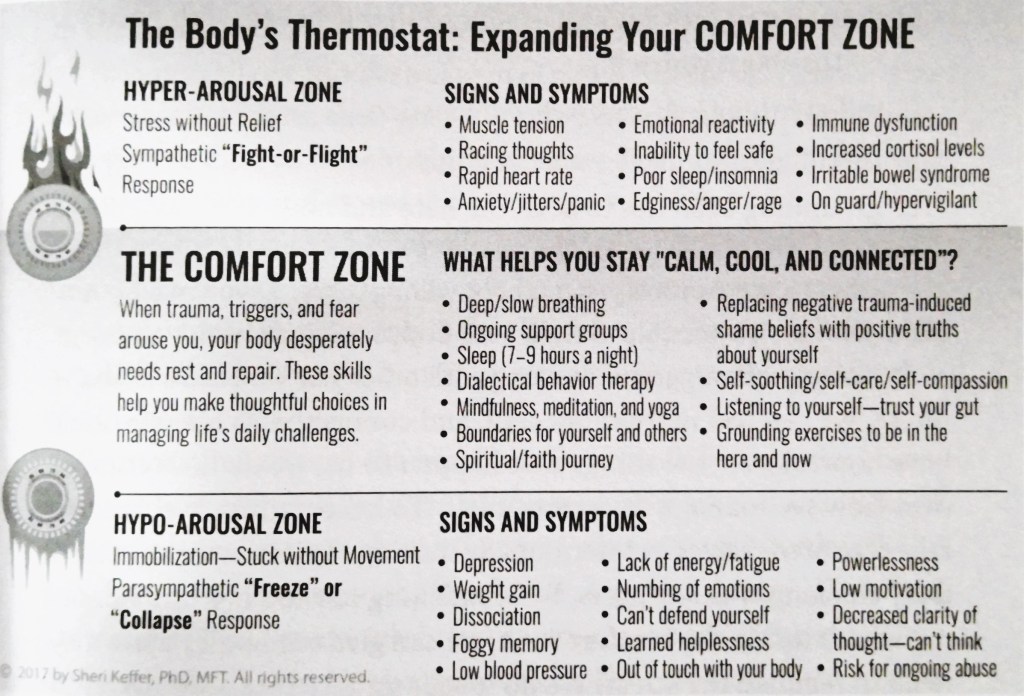
The undertone illuminates the impact of trauma, where nothing feels safe. The brain is asking, “Is it safe yet? Is the danger gone?” Even though the terror of the events from chapter 1 are over, Job’s brain remains on high alert. The amygdala is still sending danger signals. When healing hasn’t taken place, the amygdala becomes ineffective at determining threatening situations. The body becomes hyper-aroused (fight/flight) or hypo-aroused (freeze/collapse).
Job: God Charges No One
Again, this is stunning – Job agrees with Eliphaz’s definition of what the wicked do, that the wicked participate in injustice against the poor, widow, fatherless, naked, hungry, etc. Job adds murder and adultery to his list. There’s no argument from Job on that account.
However, Job diverges on this point:
From out of the city the dying groan,
and the soul of the wounded cries for help;
yet God charges no one with wrong. (23:12)
Job turns the accusations toward God. From Job’s vantage point, the wicked oppress the poor and God does nothing. They participate in injustice with impunity. This only reinforces Job’s terrified brain state. His brain scans his environment and it only detects danger with no reprieve and no rescue.
Even if you’re not going through trauma, everyone can see that injustice exists. Therefore, I’m ending with a link to one organization who is answering God’s call to seek justice on behalf of the vulnerable: International Justice Mission. I hope you are encouraged by the work they do!

 By the River Together